


Gallery View#
Browse Isaac Sim by product module instead of documentation type. Open a module to see its tutorials, tool references, and developer references together.
Browse developer references, tool references, and tutorials for GUI.
Browse tutorials and tool references for Importers and Exporters.
Browse tutorials, tool references, and developer references for Robot Setup.

Browse tool references and developer references for Robot Simulation.

Browse tool references and tutorials for Robot Motion.
Author and drive portable external actuator models from Python, USD, the UI, and OmniGraph.
Physics fundamentals, engine integration, backends, limitations, and simulation tools.
Browse tool references and tutorials for Camera Sensors.
Lidar, radar, acoustic, annotator, material, and advanced RTX sensor references.
Articulation force, contact, effort, IMU, joint-state, raycast, and sensor schema references.

Browse developer references for Development Tools.
Python concepts, the standalone environment, and runnable snippets.
Browse tool references and tutorials for OmniGraph.
Bridge Isaac Sim to external processes and protocols.
Extension templates and generator tools for scaffolding new Isaac Sim projects.
Debug, inspect, and profile simulations and extensions.
Warehouse logistics tools, occupancy maps, and live camera streaming.
GUI#

Access frequently used Isaac Sim GUI tools and related Omniverse GUI extensions.
Reference the opening page, menu bar, toolbar, and main UI windows.

Look up viewport, stage, and editing hotkeys in one table.
Reference Create menu items for scene creation and layout.
Reference Replicator menu tools for generating, visualizing, and recording synthetic data.
Find menu entries that Isaac Sim places differently from stock Kit applications.
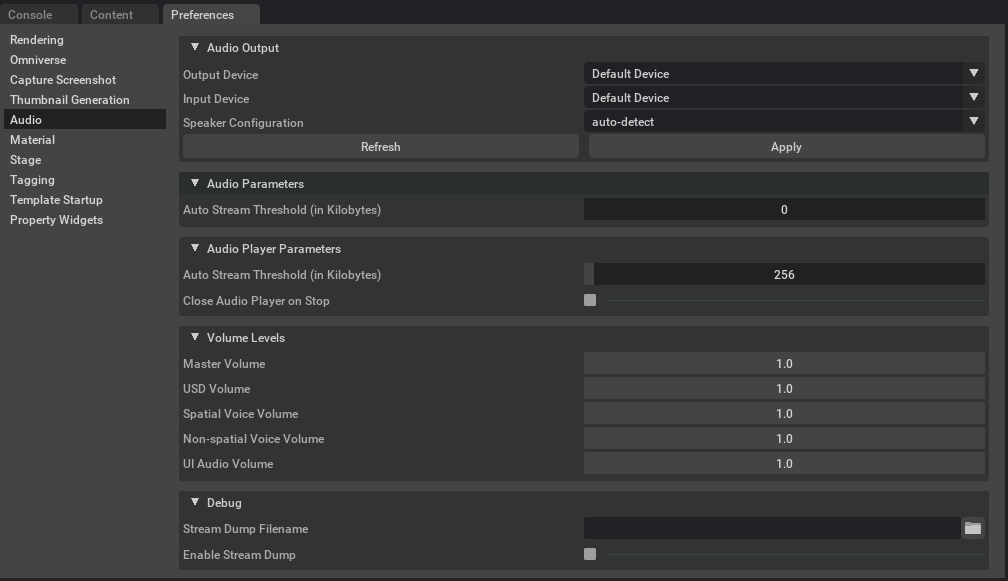
Reference commonly modified application settings in the Preferences panel.
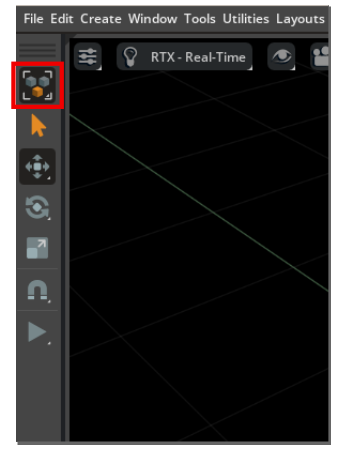
Reference type and model-kind selection modes and their toolbar controls.
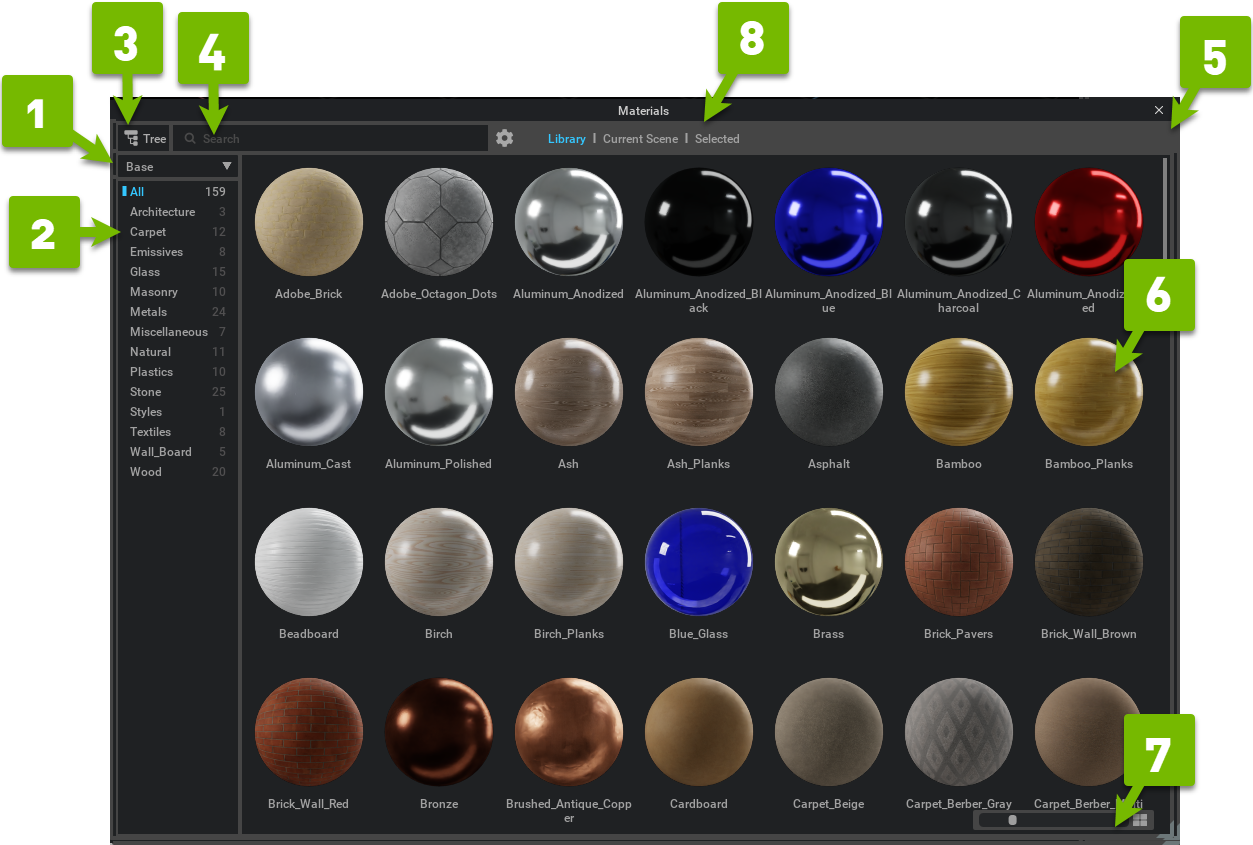
Manage assets and scenes with the Content, Asset, and Material browsers.
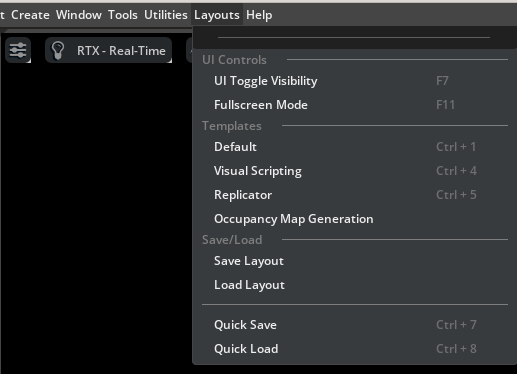
Reference predefined layout templates and save or load custom GUI layouts.
Save, load, reference, and collect USD stages from the Isaac Sim UI.
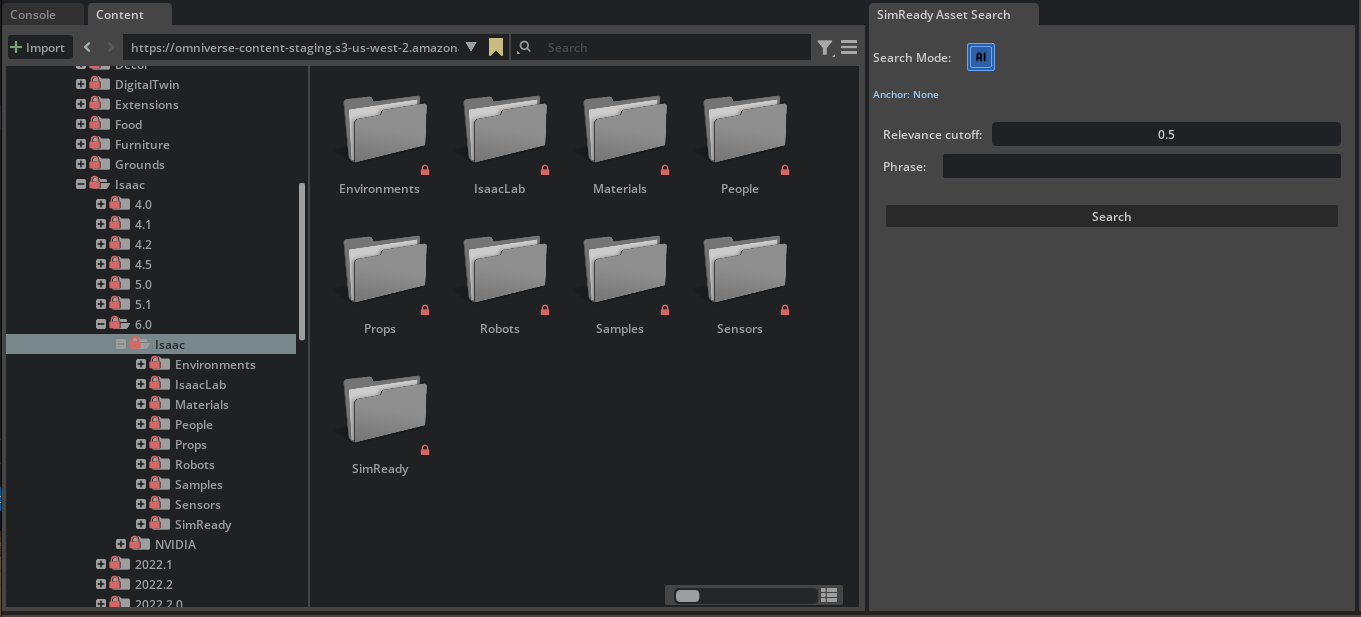
Search local folders and AWS S3 buckets for SimReady assets.
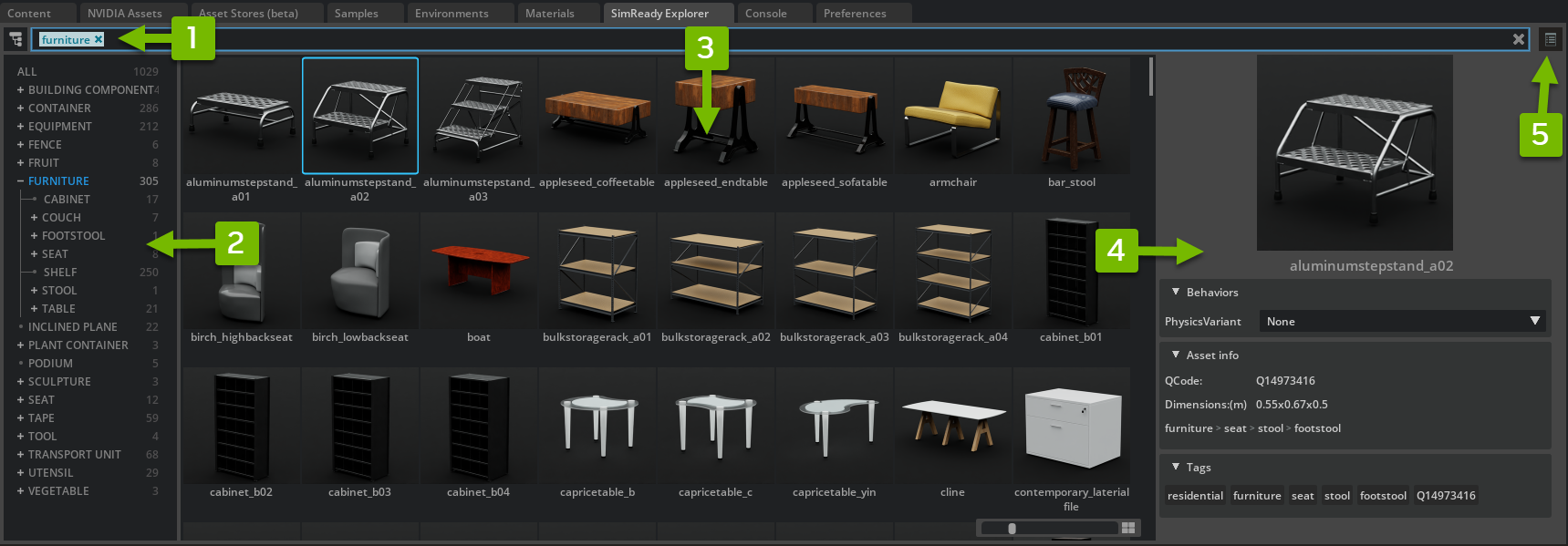
Search, inspect, and configure simulation-ready assets before adding them to the active stage.
Importers and Exporters#
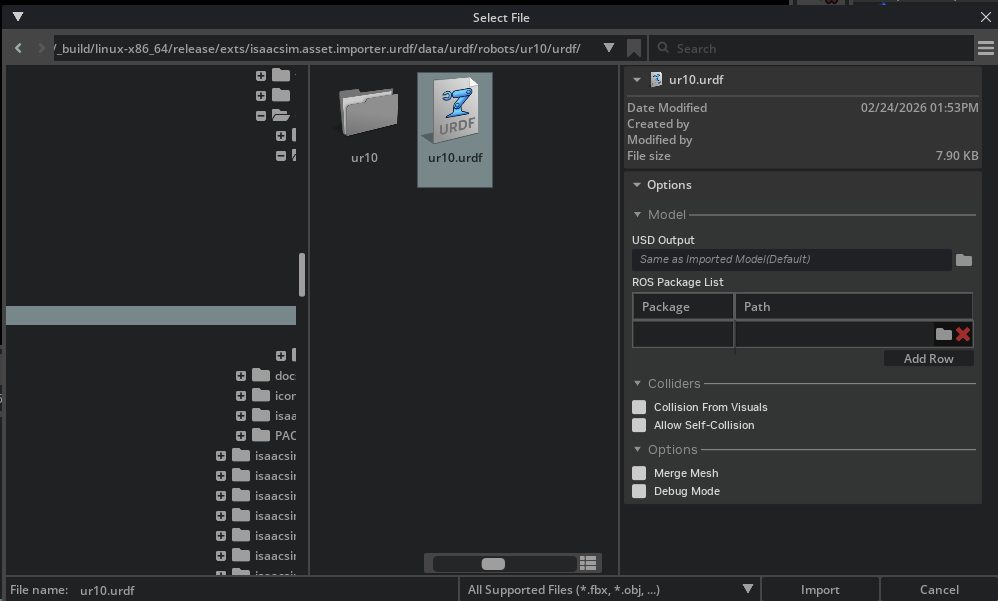
Import URDF robot descriptions through the Isaac Sim UI and extension API.

Export a USD stage or file to a URDF package.
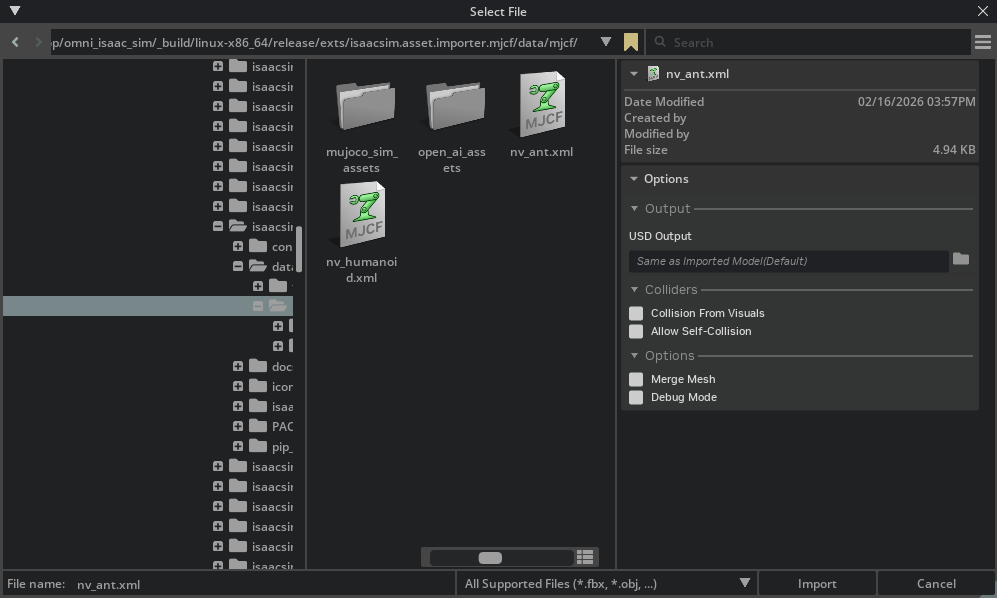
Reference MJCF import settings and extension behavior.
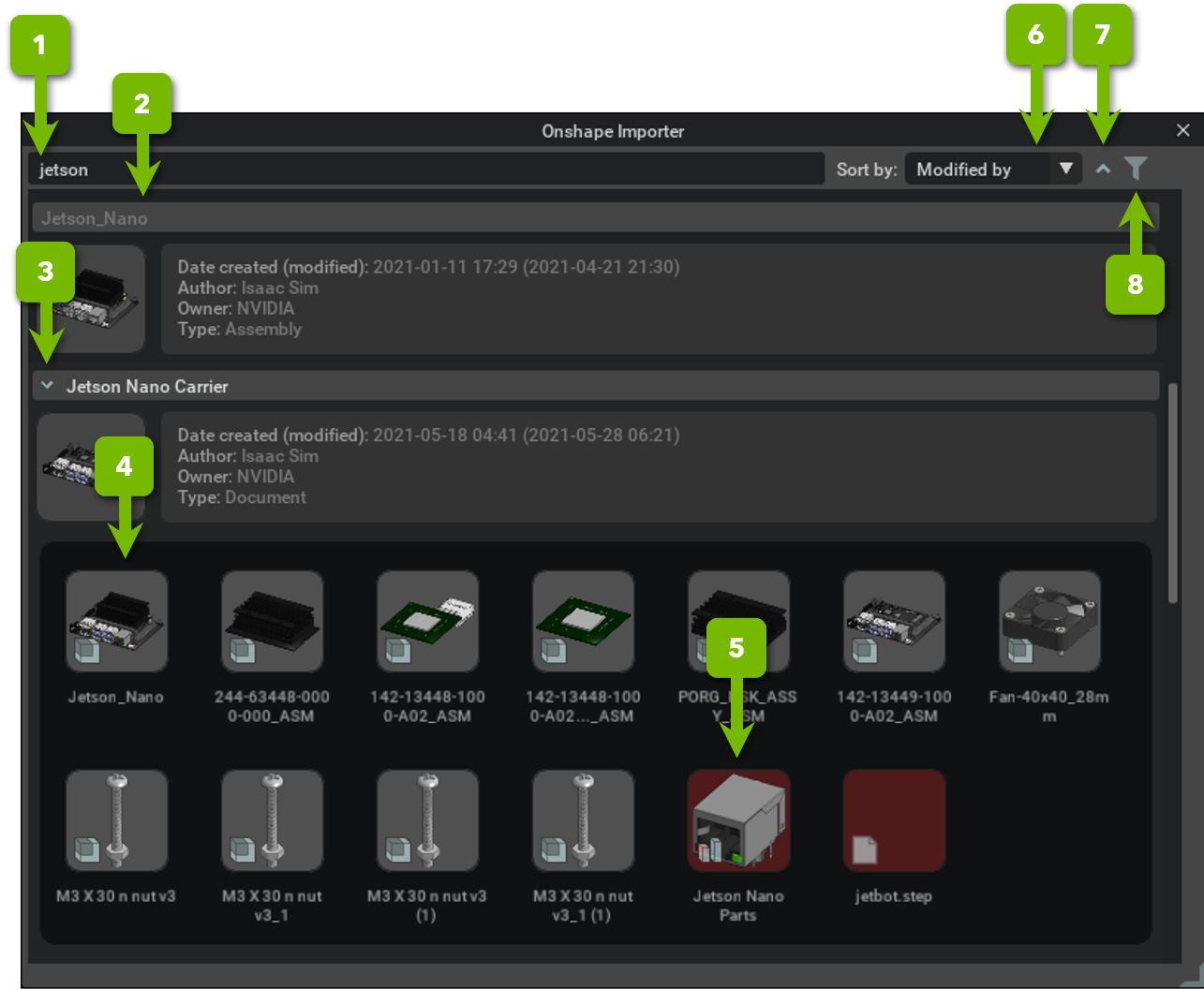
Import Onshape documents into USD.

Convert supported CAD formats to USD.
Import ShapeNet models as ordinary OBJ files instead.
Reference the asset formats the Omniverse converters bring into USD.
Convert URDF to USD through the UI, Python, a standalone script, or a ROS 2 node.
Export a robot USD to URDF and validate its visual and collision mesh output.

Import MJCF models through the UI, API, or a standalone Python script.
Review the deprecated ShapeNet workflow and use standard OBJ import for new projects.
Robot Setup#

Basic Stage and Robot Setup
Set up a physics-ready stage, assemble and articulate a basic robot, add a camera, and rig a wheeled robot.

Setup a Manipulator
Import and assemble a UR10e manipulator, configure its physics and motion-planning data, then run pick-and-place examples.
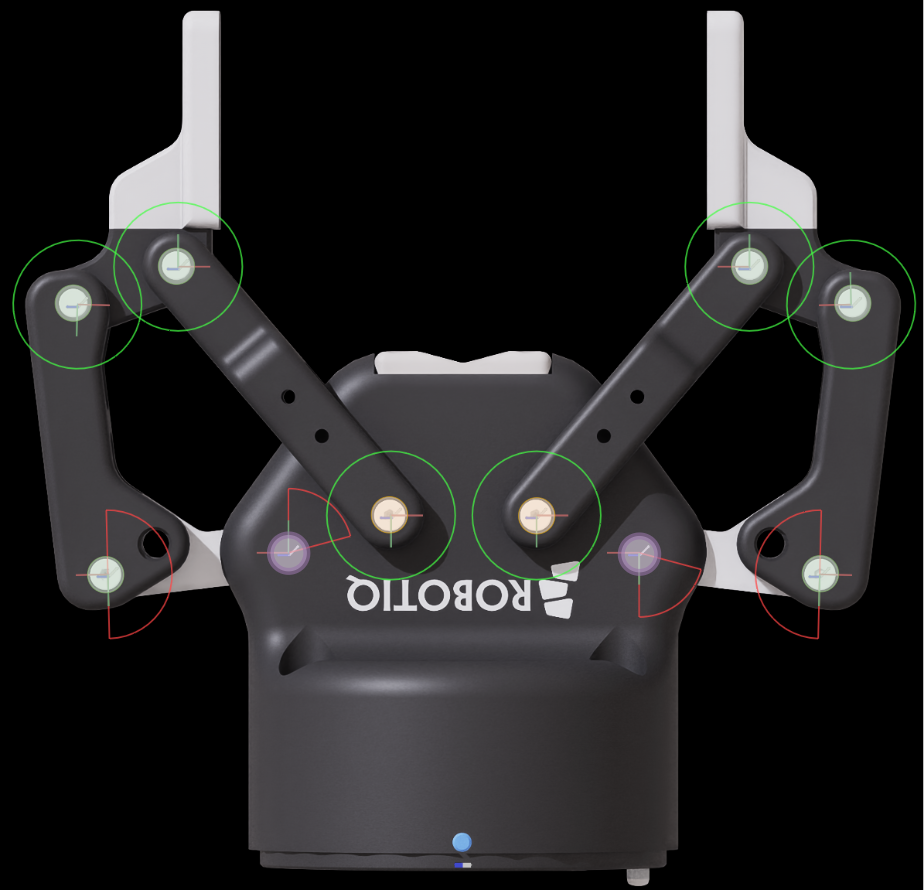
Rig and validate a closed-loop gripper structure with joints, mimic joints, and tests.

Rig H1 joint defaults to match a locomotion policy for an external controller such as ROS.

Setup a Dexterous Hand in Isaac Sim
Import, inspect, and tune the Inspire Hand so it moves with stable, critically damped motion.

Tuning and Optimization
Tune joint-drive gains, optimize robot assets, and identify simulation parameters from recorded or synthetic motion.

Asset Transformer Tutorial Series
Transform assets with built-in profiles, then author, save, modify, and script rule profiles.

Robot Assembler, Robot Poser, mesh merge, gain tuning, system identification, and self-collision tools.

Attach two robots or rigid bodies with a fixed joint using the Robot Assembler tool.
Reference surface gripper setup, APIs, and OmniGraph nodes.

Author, simulate, import, and export grasp files with the Grasp Editor.

Robot Inspector, Joint Inspector, Physics Inspector, and Simulation Data Visualizer references.

Import and author robot assets for Newton with the correct USD layers, physics attributes, and actuator formulation.
Troubleshoot reparenting, rigging, joint, and simulation issues in robot setup.

Reference validation workflows for checking robot asset quality.

Reference the Asset Transformer UI, rule profiles, reports, and actions.

Covers programmatic Asset Transformer usage, API classes, and custom rule development.
Reference every built-in Asset Transformer rule by package and function.

Explain modular robot asset layers, including optional ROS integration stacks.

Explain Isaac Sim robot USD schemas and authored robot properties.
Robot Simulation#

Understand the controller hierarchy, robot types, and simulation guidance in this section.
Reference Python and OmniGraph interfaces for joint position, velocity, and effort control.

Explain differential, wheel base, and mobile robot controller concepts.
Best practices for simulation performance, time stepping, friction, grippers, colliders, and masses.

Find foundational simulation and Core API concepts used throughout robot simulation.
Newton Actuators#

Understand Newton actuator models, construction paths, and current limitations.
Build Newton actuator configurations in Python and drive a robot articulation.
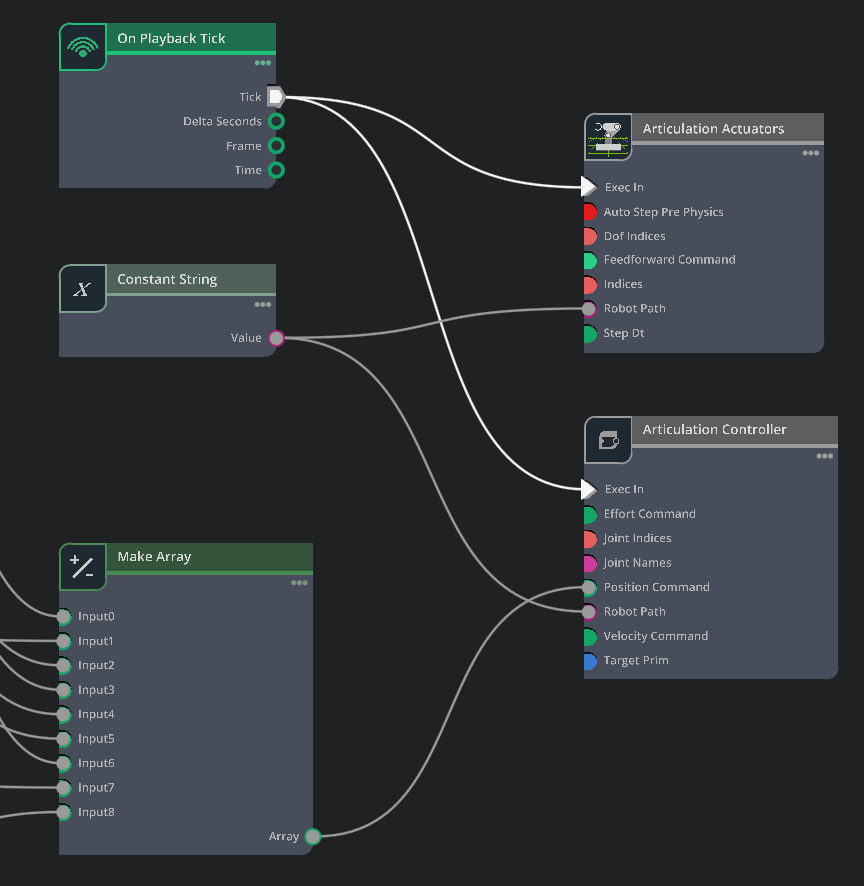
Author portable Newton actuator prims in USD and discover them at runtime.

Create Newton actuator prims and configure targets, controllers, and effort limits in the UI.

Drive USD-authored Newton actuators from an OmniGraph node.
Review common setup, debugging, and tuning considerations for Newton actuators.
Robot Motion#
Understand the unified motion API, controller integrations, and behavior-programming workflows.
Get a wheeled robot or manipulator moving with a ready-made controller.

Motion Generation
Understand the Motion Generation API for reading scene data and controlling robot motion.

Controllers
Reference, configure, and drive differential-drive, Ackermann, and holonomic mobile robot controllers.
View all 3 steps
cuMotion Integration
Learn the cuMotion integration from robot configuration and world state through RMPflow, planning, and trajectory workflows.
PINK Integration
Learn the PINK integration from robot configuration to inverse-kinematics control and weighted multi-task behaviors.
Run interactive and standalone Franka pick-and-place action sequences.

Structure reactive manipulation tasks with a finite state machine, behavior tree, or declarative transitions.

Legacy Lula motion-generation concepts, interfaces, tools, and tutorials. Use Robot Motion for new development.
Physics Simulation#
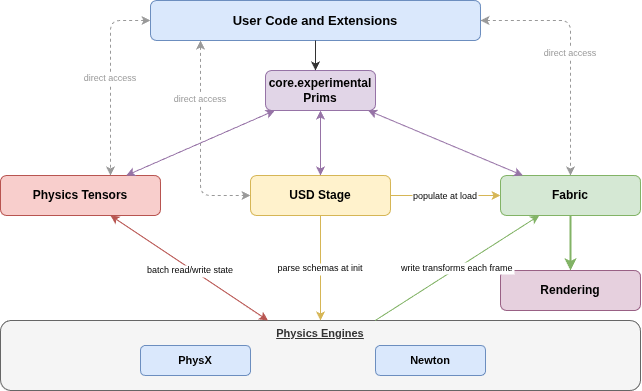
Understand the simulation pipeline, supported physics backends, and engine integration architecture.
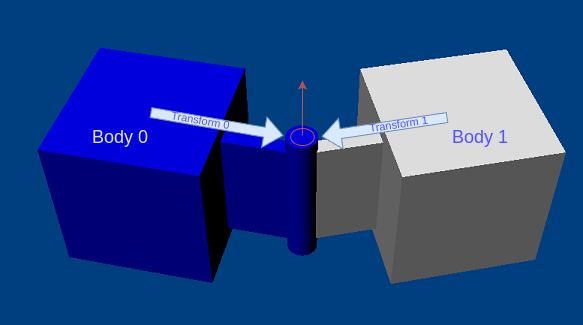
Understand simulation timing, physics scenes, colliders, contacts, and materials.
Follow physics data across USD, Fabric, tensors, and engine integrations.
Configure the Newton backend and understand its integration with Isaac Sim.

Understand the Newton hydroelastic contact model, collision pipeline, and SDF parameters.

Prepare and validate a threaded nut-and-bolt assembly for Newton hydroelastic contact.
Review known PhysX engine limitations and available workarounds.
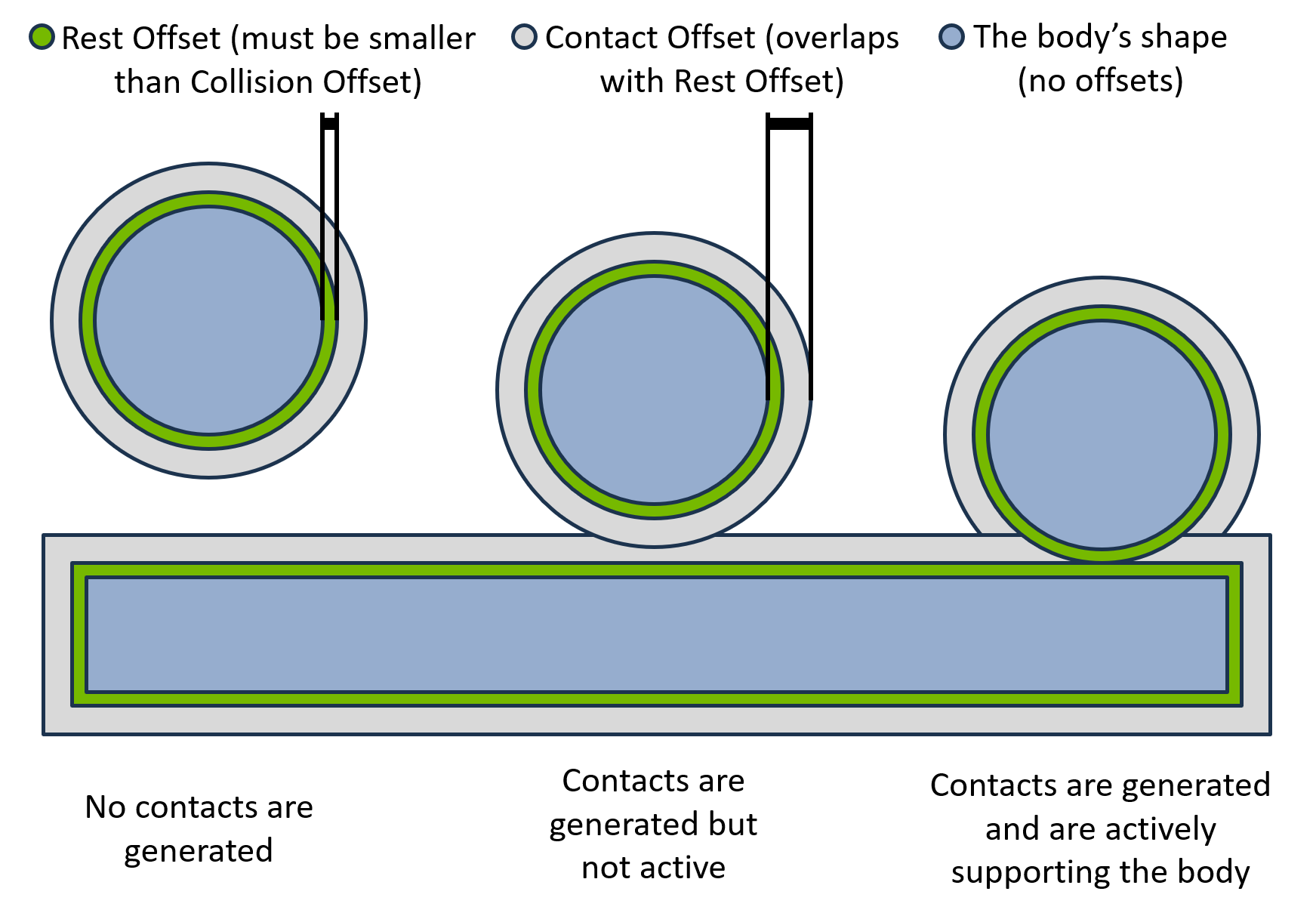
Manage simulation state, stepping, and physics-scene controls.

Inspect articulation and joint properties from the Physics Inspector.
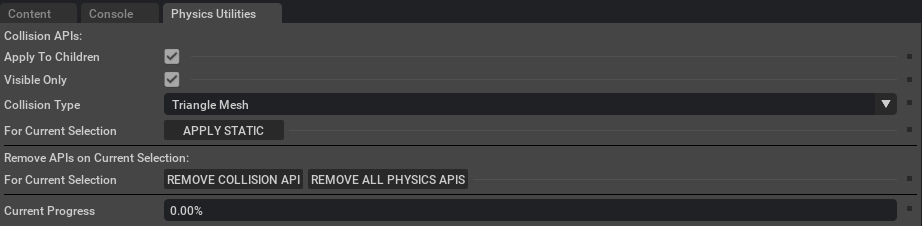
Apply, remove, and visualize static collision APIs on stage geometry.
Visualize runtime transforms, velocity, acceleration, mass, and inertia.

Inspect low-level PhysX simulation and debug visualization state.
Camera Sensors#

Understand camera creation, calibration, rendering, annotators, and available camera models.

Create and use single-view stereoscopic depth camera sensors.

Author structured-light projectors and acquire their rendered camera data.

Build a reusable USD camera sensor with distortion, outputs, tick rates, and resolution variants.
RTX Sensors#

Understand RTX sensor simulation, shared settings, data channels, timing, and migration guidance.
Configure and use RTX lidar sensors and point-cloud output.

Configure RTX radar sensors, motion BVH, and radar point-cloud output.
Configure acoustic sensors and consume signal-way output.
Extract point clouds, scan buffers, and raw RTX sensor data.
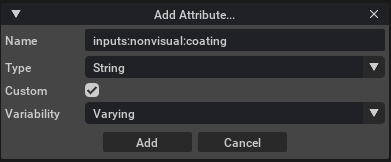
Add non-visual material attributes used by RTX sensors.

Coordinate independent sensor render rates with simulation timing.
Create and tune custom RTX lidar and radar sensor profiles.
Physics-based Sensors#

Understand exact physics measurements, sensor update rates, interpolation, and migration guidance.
Read incoming and projected articulation joint forces.
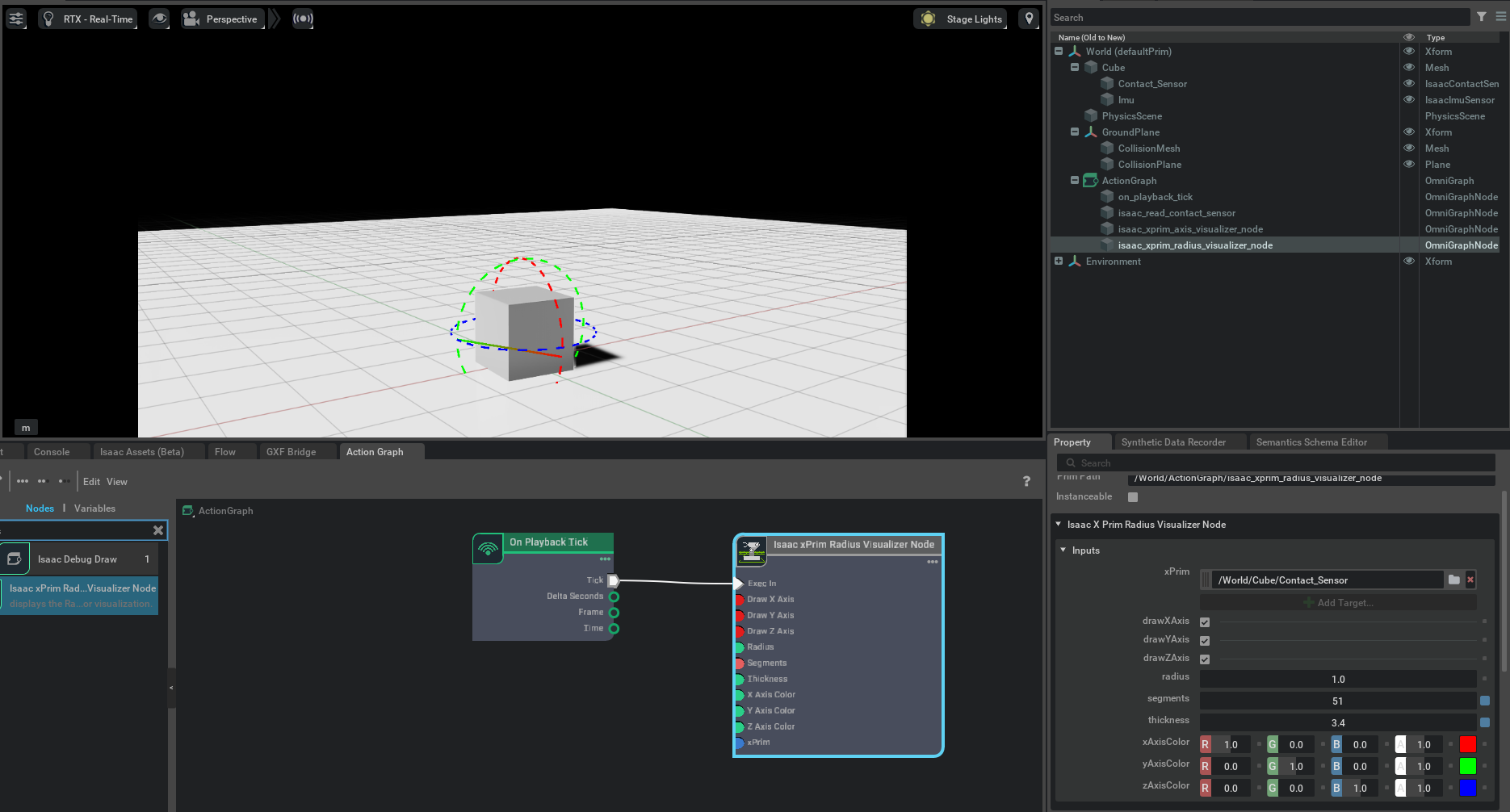
Create contact sensors and read contact-force measurements.

Read simulated effort measurements from articulation joints.

Configure IMU sensors and read filtered inertial measurements.
Read articulation position, velocity, and effort state.
Author ray patterns and read exact physics raycast hits.
Reference USD attributes for contact, IMU, raycast, and deprecated sensor schemas.

PhysX SDK Sensors
Legacy PhysX generic, lidar, lightbeam, and proximity sensor references.
View all 4 steps
Development Tools#
Compare GUI, Extension, and Standalone Python development methods and understand how they combine.

Execute Python on a running Isaac Sim instance directly from VS Code.
TCP server that executes Python remotely inside a running Isaac Sim instance.

Edit and execute Python interactively in Jupyter attached to Isaac Sim.

Run Python snippets against the stage in the built-in Script Editor.
MCP server that gives AI assistants Isaac Sim knowledge via semantic search.
Version-controlled workflow guides that teach AI coding agents Isaac Sim tasks.
Covers four ways to change Carb settings that configure default behaviors.
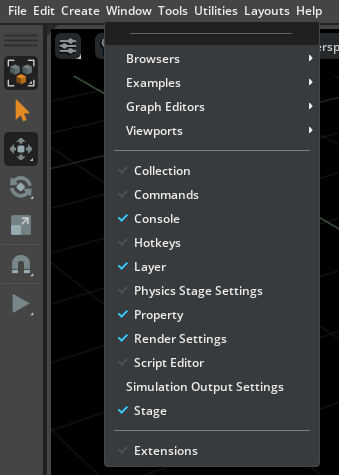
Add local extension paths or registries and update installed extensions.
Python Scripting#
Explains python.sh internals, standalone script execution, and Python development resources.
Create rigid prims, views, physics scenes, collisions, materials, and transforms with Python snippets.

Run utility snippets for async tasks, camera parameters, and point rendering.
Wrap articulations and query or control robot DOF state with experimental prim APIs.
OmniGraph#

Understand OmniGraph visual programming, compute graphs, and how to work with the graph editor in Isaac Sim.
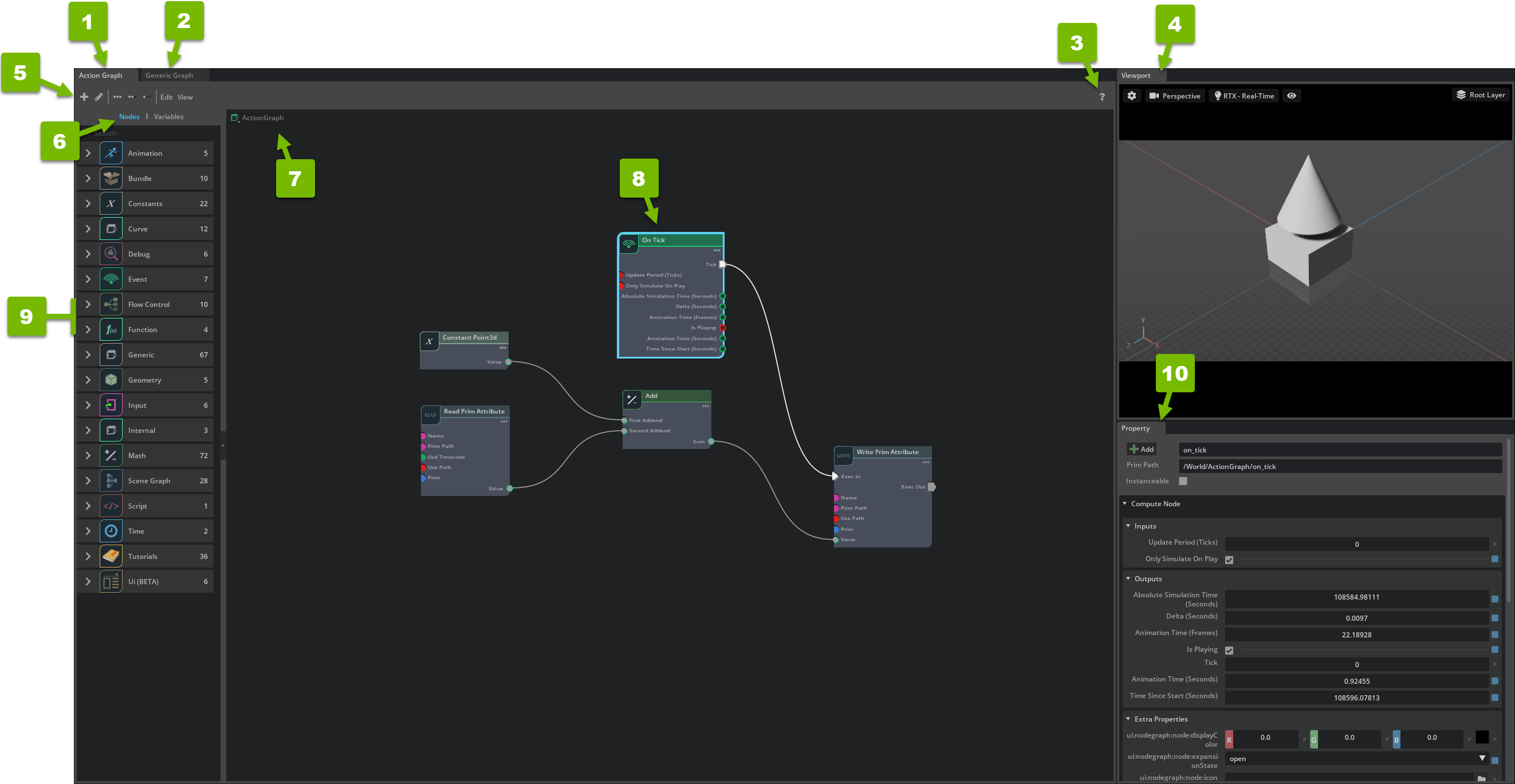
The Omniverse reference for the OmniGraph editor interface.
The Omniverse reference for OmniGraph core concepts.
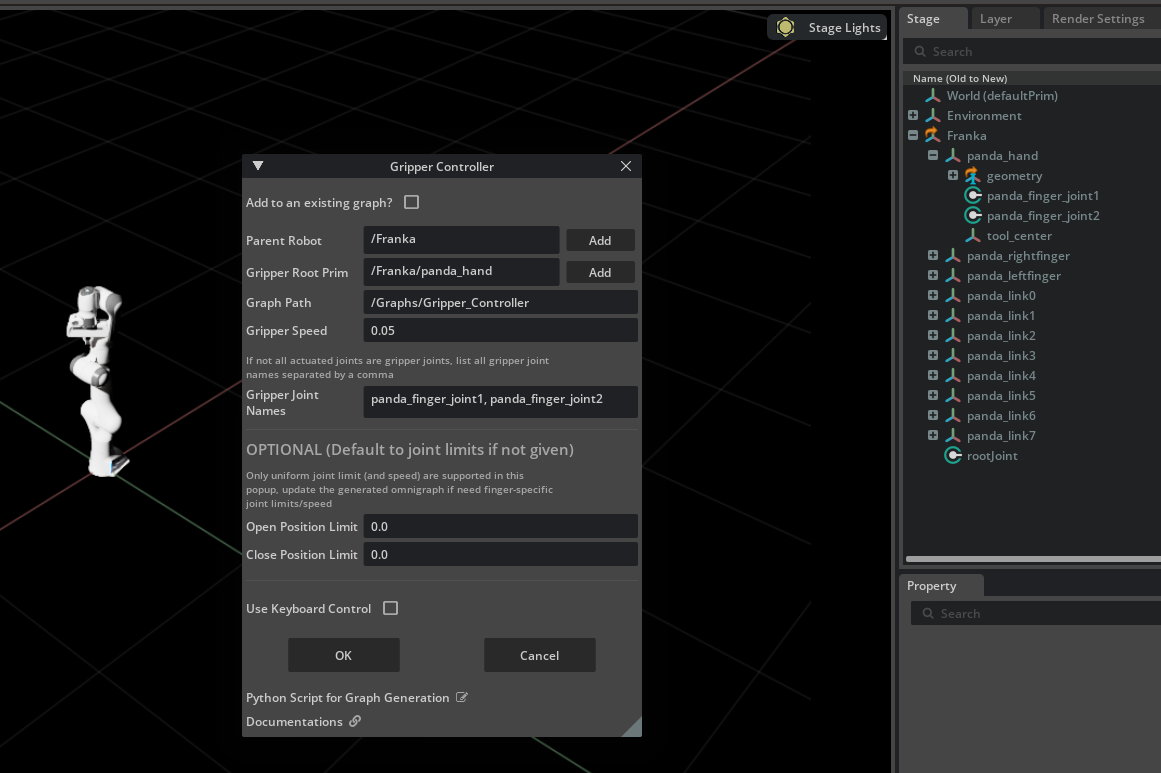
Look up frequently used Isaac Sim OmniGraph nodes and shortcuts.
Write, register, and test custom OmniGraph nodes in Python.
Write, build, and register custom OmniGraph nodes in C++.
Stream data between Isaac Sim and external processes with custom IPC nodes.
Use the built-in IPC nodes to move data in and out of a graph.

The full Omniverse OmniGraph extension documentation.
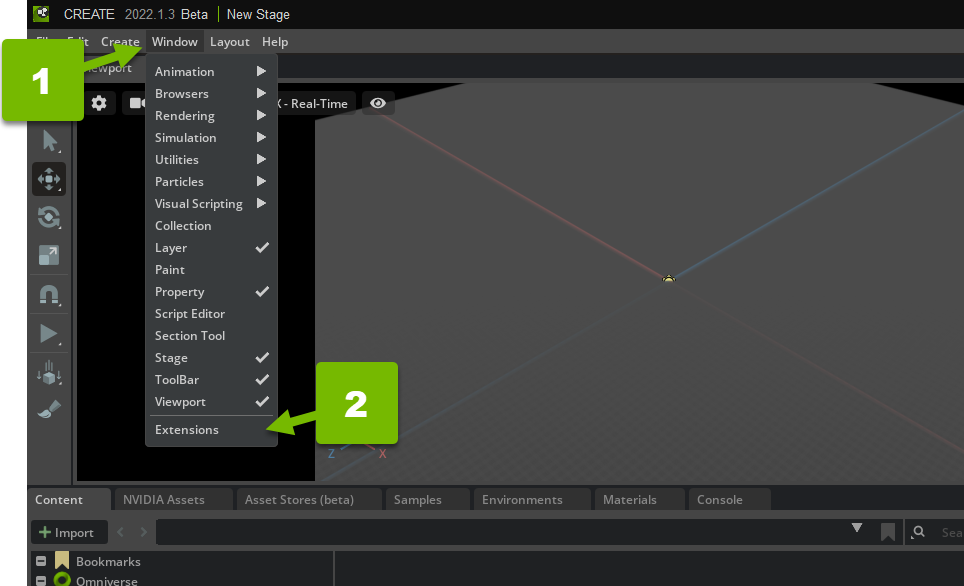
A gentle Omniverse introduction to building your first graph.

Build an Isaac Sim action graph controlling a robot step by step.
Author and drive OmniGraph graphs from Python scripts.
External Interfaces#

Stream simulation data to an external Python process and send commands back over ZeroMQ.
Templates#

Choose among CLI, UI, and VS Code generators for extension projects, or start a standalone project from the bundled examples.
Scaffold Python, UI, C++, and OmniGraph extensions with repo.sh templates.

Deprecated UI-based generator that scaffolds UI extension projects from built-in templates.
Generate advanced Isaac Sim extension templates from the VS Code extension.
Debugging and Profiling#

Draw persistent debug lines and points that stay visible across frames.

Shows the Python command behind each UI operation in the Commands window.
Find registered Kit commands and actions and call them from Python.

Debug standalone scripts, Docker scripts, and running Isaac Sim apps in VS Code.

Profile Isaac Sim with Tracy and add Python or C++ profiling zones.
Other Tools#

Run cuOpt warehouse logistics examples and create routing networks.

Generate occupancy maps and heightmaps from physics collision geometry.

Stream simulated camera render products over RTSP to standard clients.