


[isaacsim.robot.policy.examples] Reinforcement Learning Inference Example for Robots in Isaac Sim#
Version: 7.2.0
Overview#
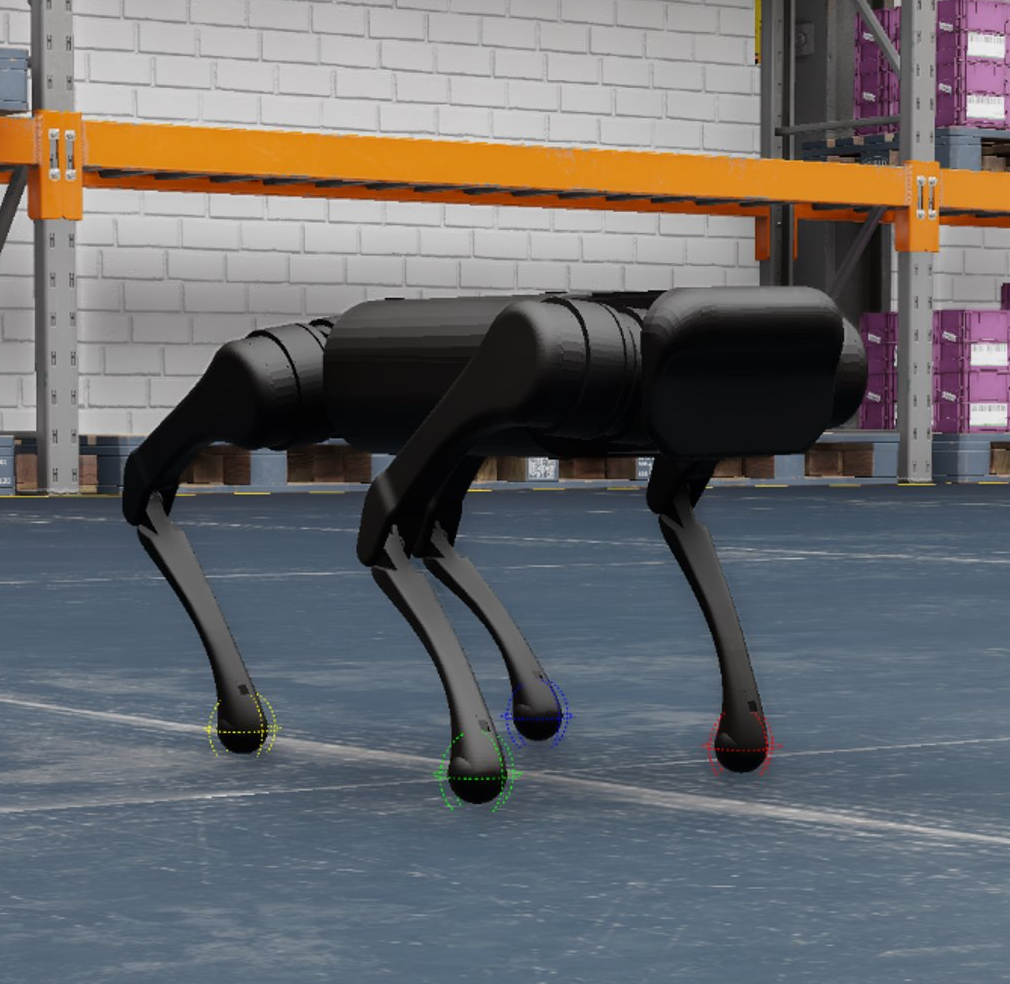
The isaacsim.robot.policy.examples extension deploys reinforcement-learning policies exported from Isaac Lab into Isaac Sim. One policy-specific runner drives the six bundled examples (ANYmal-C, Spot, Go2, H1, Franka drawer opening, and Cartpole) on the supported PhysX and Newton configurations.
Quick Start#
Deploy the bundled Spot policy through the same public path used by the standalone, interactive, and MobilityGen examples:
import numpy as np

from isaacsim.robot.policy.examples import RobotPolicyRunner, get_spot_spec

# Author the robot while the timeline is stopped.
spot = RobotPolicyRunner(get_spot_spec(), prim_path="/World/Spot")
spot.spawn()

# Start from the configured default state and establish the first target after play begins.
spot.restart_from_default_state([0.0, 0.0, 0.0])

# Call once per physics tick from the caller-owned callback.
def on_physics_step(step_size: float) -> None:
    spot.step(step_size, np.array([1.0, 0.0, 0.0], dtype=np.float32))
The selected artifact supplies the policy model, environment configuration, and IO descriptor. The runner deploys the policy trained for the active physics engine unless training_engine selects another, authors the selected robot USD, binds the policy interface, loads the model, and owns cadence, target writes, explicit actuators, and cleanup.
A replay reset is deliberately explicit: use restart_from_default_state(command) to restore the configured state and establish its first target atomically. For a custom state, restore or teleport the robot first, then call initialize() so controller state is reset after the discontinuity. Later initialize calls never teleport the robot. Call close() to release model, controller, and actuator resources.
Architecture#
There is one intentionally narrow MotionGen boundary:
PolicyArtifact + PolicyEnvConfig + PolicySpec
                    |
                    v
          IsaacLabPolicyController
              (BaseController)
                    |
             desired RobotState
                    v
               RobotPolicyRunner
       read -> infer -> hold -> apply
                    |
                    v
          Articulation + actuators
IsaacLabPolicyController
is articulation-independent. One forward call builds an observation, runs one inference, updates
its own previous-action feedback, and decodes a desired RobotState. It owns no USD, articulation,
physics cadence, or target application.
RobotPolicyRunner is a policy
deployment facade, not a generic controller-composition runtime.
The root package exports the deployment types, the bundled get_*_spec factories, the Franka
provider factory, and the 6.x class names as raising migration shims. Descriptor binding, model
backends, articulation bridging, and actuator resources stay subsystem internals.
Artifacts and Custom Policies#
PolicyArtifact groups one policy
model with its env config and IO descriptor:
from isaacsim.robot.policy.examples import PolicyArtifact, RobotPolicyRunner, PolicySpec

artifact = PolicyArtifact.from_training_run(
    "/path/to/logs/rsl_rl/my_task/2026-07-20_10-00-00",
    model_sha256=trusted_release_manifest["policy.pt"],
)
spec = PolicySpec(name="my_robot", engines={"physx": artifact})
runner = RobotPolicyRunner(spec, prim_path="/World/MyRobot")
from_files() accepts explicit local or Omniverse paths. from_bundle() reads a flat deployment bundle. from_training_run() reads an Isaac Lab run, prefers its deployable exported policy over raw checkpoints, and fails on ambiguous or missing files. Every TorchScript artifact requires its full SHA-256 from a trusted release manifest; the runner verifies the bytes again before every deserialization, including cache hits.
The two exported configuration files have separate authority:
IO_descriptors.yaml defines ordered observation/action terms, shapes, joint order, scales, clips, and offsets.
env.yaml defines physics timing, spawn properties, joint gains and limits, actuator models, and initial state.
PolicySpec adds only deployment facts not carried by those exports: per-engine artifacts, an optional robot USD and spawn defaults, and an advanced binding hook for an interface that the descriptor exporter cannot represent. When no USD or pose is in the spec, the env config is the fallback.
Descriptor Contract#
Binding is internal to the deployment path. The supported observation vocabulary is base linear/angular velocity, projected gravity, a planar [vx, vy, wz] command, absolute or default-relative joint position/velocity, and previous raw action. Supported outputs are named joint position, velocity, and effort commands.
Derivation preserves descriptor order and each record’s selected joint names and offsets. Compilation resolves those names against the live articulation, applies the exported affine transforms, and records the requested control modes. Joint names bind literally: the deployed articulation must expose the trained names, and unsupported term paths or missing joints fail at binding; the model runtime separately validates its flat float input and output widths. The deployment path trusts the staged descriptor and does not interpret its dtype, history, modifier, or articulation-sidecar metadata.
Franka is the one bundled exception: Isaac Lab’s exporter omits its custom drawer-distance term. Its bundled module therefore supplies a concrete binding and a task provider with explicit robot and cabinet paths. That policy-specific adapter does not create a general scene-query schema.
Bundled Examples#
The isaacsim.robot.policy.examples.bundled package provides one get_engines, usd_path,
name, default_spawn_position, default_spawn_orientation,
zero_targets_on_initialize, and binding. Omitted fields keep the bundled value, while an
explicit None replaces it. For example: get_h1_spec(default_spawn_position=(0.0, 0.0, 1.2)).
MobilityGen uses the same H1 and Spot specs; RobotPolicyRunner authors the selected engine asset, the
policy artifact determines the physics timestep, and session teardown closes the runner.
Hosted policy bundles do not yet carry every IO descriptor beside the model and env config, so validated exports are staged under data/descriptors. Cartpole shares one engine-neutral descriptor; Franka binds explicitly.
Lifecycle and Failure Behavior#
Use this ordering:
Construct the runner and call spawn() while stopped.
Start physics and call initialize().
Call step(dt, command) exactly once per physics tick.
Before a replay or external teleport, restore the robot state, then call initialize().
Call close() during teardown.
Tick zero runs inference. Later control ticks follow the artifact decimation and write the desired state; the engine holds that command, so intermediate ticks write nothing. A reset occurs immediately before the next forward call, controller time is absolute within each run, and state is read only on control ticks. A failed reset leaves the runner uninitialized; step errors propagate to the caller.
Migrating from extension 6.x#
Version 7.0.0 removed PolicyController and the six articulation-owning policy classes. This is
an extension API version change, not an Isaac Sim product-version migration. The old import paths
remain as shims: imports still resolve, but constructing one of the classes raises a RuntimeError
carrying its replacement code.
Extension 6.x symbol |
Extension 7.0.0 construction |
|---|---|
AnymalFlatTerrainPolicy |
RobotPolicyRunner(get_anymal_spec(), prim_path=…) |
SpotFlatTerrainPolicy |
RobotPolicyRunner(get_spot_spec(), prim_path=…) |
Go2FlatTerrainPolicy |
RobotPolicyRunner(get_go2_spec(), prim_path=…) |
H1FlatTerrainPolicy |
RobotPolicyRunner(get_h1_spec(), prim_path=…) |
CartpolePolicy |
RobotPolicyRunner(get_cartpole_spec(), prim_path=…), stepped without a command |
FrankaOpenDrawerPolicy |
RobotPolicyRunner(get_franka_spec(), …, task_state_provider=make_franka_task_state_provider(cabinet, env_config)) |
PolicyController.load_policy |
PolicyArtifact.from_files(…) plus PolicySpec |
The lifecycle changes with it: author the robot while the timeline is stopped, initialize()
after physics starts, then step() once per physics tick. The runner owns policy decimation, so
callers no longer count ticks.
Worked examples for each case – shipped policies, non-shipped policies, exporting
IO_descriptors.yaml from an Isaac Lab run, and the supported term vocabulary – are in the
migration guide.
Integration#
The controller uses the BaseController and RobotState contract from isaacsim.robot_motion.experimental.motion_generation. Explicit exported actuator models come from isaacsim.core.experimental.actuators; articulation access uses isaacsim.core.experimental.prims. ONNX policies run through isaacsim.pip.onnx.
Enable Extension#
The extension can be enabled (if not already) in one of the following ways:
Define the next entry as an application argument from a terminal.
APP_SCRIPT.(sh|bat) --enable isaacsim.robot.policy.examples
Define the next entry under [dependencies] in an experience (.kit) file or an extension configuration (extension.toml) file.
[dependencies]
"isaacsim.robot.policy.examples" = {}
Open the Window > Extensions menu in a running application instance and search for isaacsim.robot.policy.examples.
Then, toggle the enable control button if it is not already active.
- Public API for module isaacsim.robot.policy.examples:
- Public API for module isaacsim.robot.policy.examples.interactive.franka:
- Public API for module isaacsim.robot.policy.examples.interactive.go2:
- Public API for module isaacsim.robot.policy.examples.interactive.humanoid:
- Public API for module isaacsim.robot.policy.examples.interactive.quadruped: