


[isaacsim.robot_setup.sysid.ui] System Identification UI (Beta)#
Version: 1.5.0
Overview#
System Identification UI#
Beta: This extension is in beta. Its workflow, run contracts, exported run specifications, and APIs are not guaranteed to stay future compatible.
This extension provides the interactive System Identification window, menus, plots, file pickers, and viewport integration.
It depends on isaacsim.robot_setup.sysid, which owns the headless runtime, run contracts, optimizers, and simulator bridges. Enable only the backend extension for headless workflows; enable this extension for the Tools > Robotics > Asset Editors > System Identification window.
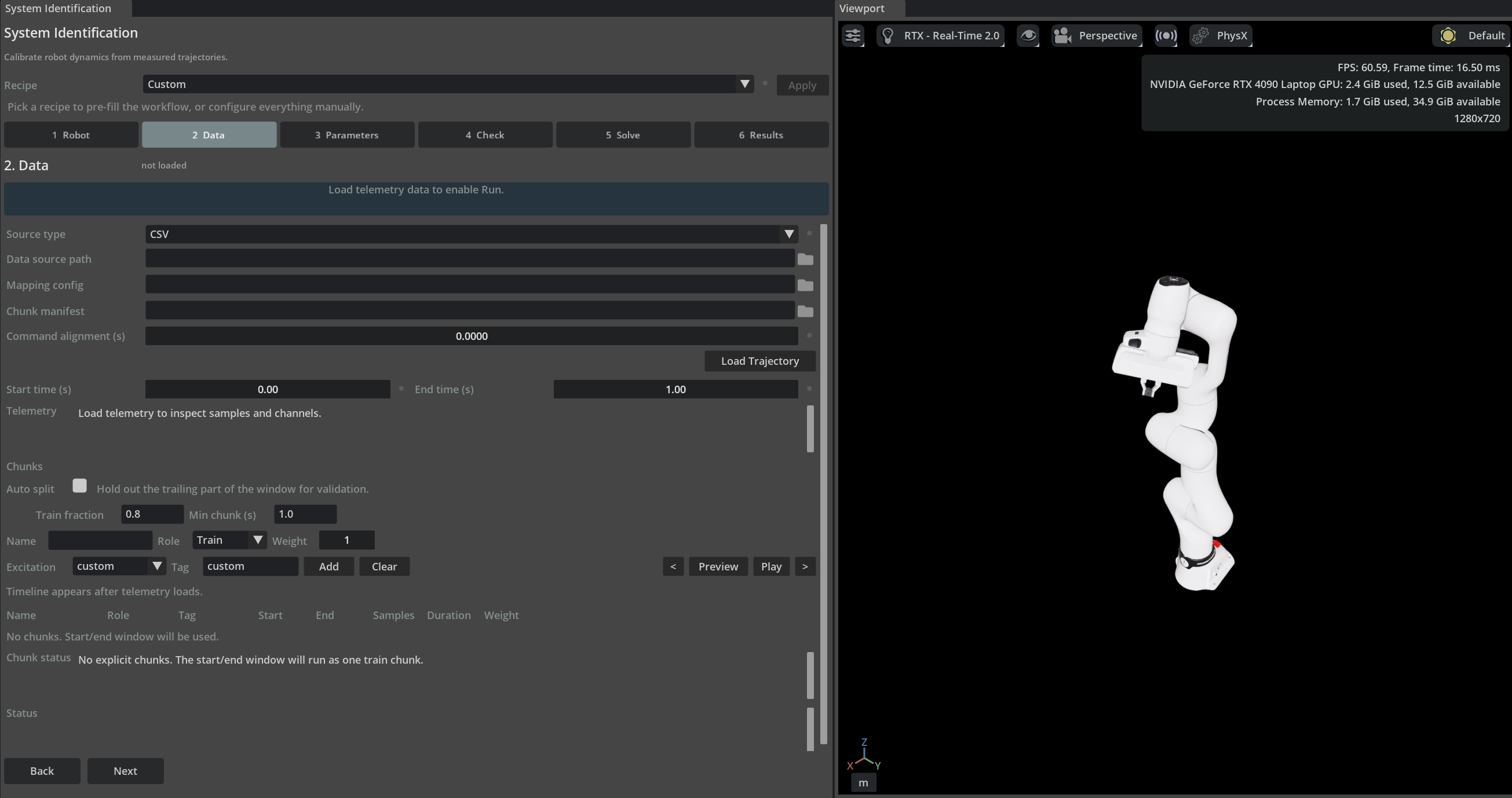
The window follows a six-stage workflow:
Robot selects the articulation, simulation engine, actuator runtime, and controller settings.
Data loads telemetry and defines an analysis window plus automatic or manual training and validation partitions.
Parameters selects the physical parameters and bounds to identify.
Check validates telemetry quality and parameter identifiability.
Solve selects residual weights, optimizer settings, and output/writeback behavior.
Results shows live cost, parameter deltas, residual summaries, sensitivity, and paired untuned/tuned validation metrics.
Run remains disabled until Check has completed for the current robot, data, parameter selection, residual configuration, and check-relevant solver settings. Changing any of those inputs requires a fresh Check. Isaac Sim rollouts also track the timeline state, so Play, Pause, and Stop immediately refresh run readiness.
Numeric solver, timing, seed, weight, and substep controls use exact-entry fields rather than drag gestures. Inputs with physical or algorithmic limits are constrained in the UI, including positive iteration counts, non-negative residual weights, and valid optimizer population sizes.
The Data page separates the overall analysis window from dataset partitioning. Automatic validation holdout accepts a training percentage and minimum partition duration. Manual chunk editor creates named training or validation intervals with excitation tags; manual chunks take precedence and temporarily disable automatic holdout. The timeline shows training, validation, and unused regions, while the scrollable table provides exact start/end inputs, sample counts, durations, and training-only weights.
Start from a recipe when possible. Recipes populate the UI widgets but remain fully editable. Review Outputs & stage changes before solving: optimized parameters are authored to the open USD stage only when writeback is enabled and completes successfully.
Interactive writeback authors overrides in the open stage’s root layer at the selected robot namespace. This keeps referenced multi-physics payloads unchanged, verifies the composed joint stiffness and damping, and refreshes the live PhysX articulation before reporting success. Save the open stage to persist the overrides. USD instance-proxy descendants cannot receive local property opinions; for an instanceable robot, create a derived non-instanceable asset or de-instance it before applying the result.
Under Advanced simulation settings, choose the in-app physics backend, actuator runtime
(auto, implicit_drive, newton_explicit, or mixed), and missing-actuator policy
(authored_only or promote_selected). These settings are retained across execution-host changes,
exported in the RunSpec, and invalidate an older Check. auto resolves to mixed ownership for Newton
MuJoCo and explicit ownership for Featherstone. Enable
Command delay in Parameters when delay should be identified; the
resulting value is quantized to the nearest simulation physics step.
The backend’s shared capability contract also gates recipes, Check, and direct runtime construction. In-app Isaac-hosted Newton currently rejects joint-friction parameters and torque/contact-force residuals because its tensor interface does not expose mutable friction, projected joint force, or incoming link force. Use Isaac Sim PhysX for the complete interactive parameter/residual surface, or standalone Newton when Newton friction identification is required. Standalone MuJoCo and differentiable Featherstone expose narrower residual and parameter sets; Check reports the exact unsupported selections before rollout.
The Results page compares RMSE from the authored launch parameters with RMSE from the accepted parameters on the exact same validation chunks. It labels the all-training-chunk fallback as training-data replay rather than held-out evidence, and shows unavailable percentage changes when the authored RMSE is zero.
Enable Extension#
The extension can be enabled (if not already) in one of the following ways:
Define the next entry as an application argument from a terminal.
APP_SCRIPT.(sh|bat) --enable isaacsim.robot_setup.sysid.ui
Define the next entry under [dependencies] in an experience (.kit) file or an extension configuration (extension.toml) file.
[dependencies]
"isaacsim.robot_setup.sysid.ui" = {}
Open the Window > Extensions menu in a running application instance and search for isaacsim.robot_setup.sysid.ui.
Then, toggle the enable control button if it is not already active.
Actions in isaacsim.robot_setup.sysid.ui#
ID |
Display Name |
Description |
|---|---|---|
CreateUIExtension:System Identification |
Open System Identification |